Using DNA Forma Lab to Generate Non-Planar BIO X Toolpaths: Over-Surface and Embedded Bioprinting Workflows
Non-planar bioprinting expands the possibilities of extrusion-based fabrication beyond conventional horizontal layers, enabling material deposition along curved surfaces and unsupported three-dimensional trajectories. DNA Forma Lab bridges digital design and printer execution by converting STL geometries into curvature-aware, BIO X-compatible G-code, while retaining familiar BIO X material handling, calibration, temperature control and photocrosslinking processes.
In the over-surface nose workflow, DNA Forma Lab was used to generate a toolpath that followed the curvature of a previously printed Pluronics 40% nose scaffold. This enabled conformal deposition of cell-laden GelMA C across the curved surface, producing a structure that retained the intended nose geometry after removal of the sacrificial scaffold.
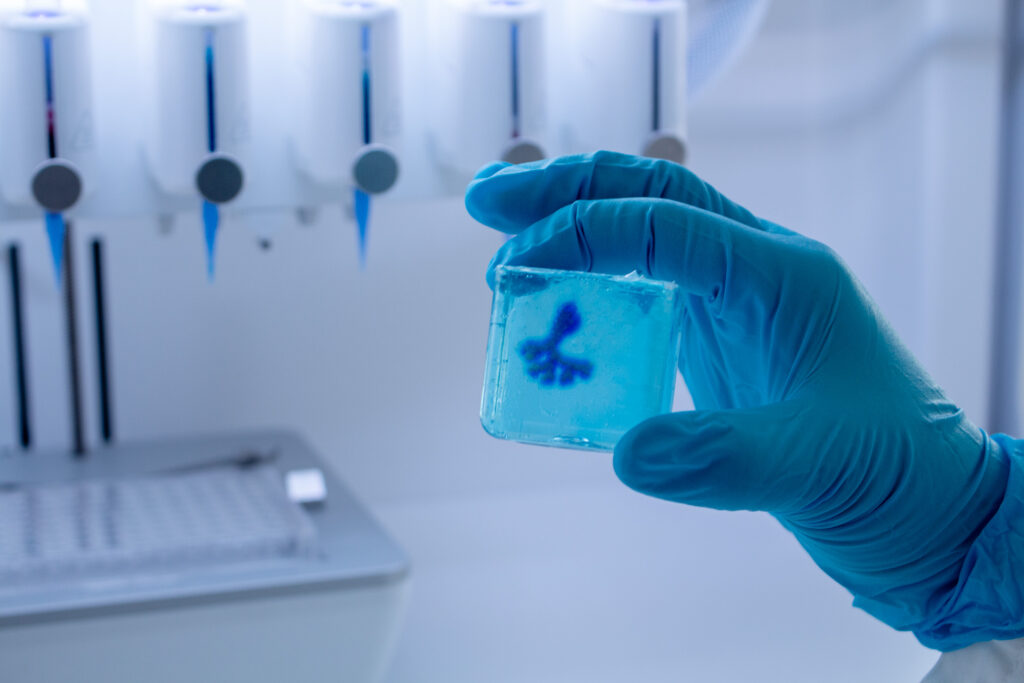
In the embedded vascular workflow, DNA Forma Lab generated a continuous non-planar trajectory for a branched, lumenised construct printed within a CELLINK START support bath. Coaxial extrusion of GelMA C around a sacrificial Pluronics 40% core enabled the fabrication of a stable, branched architecture with an open lumen after removal of the support and sacrificial materials.
Together, these workflows demonstrate how DNA Forma Lab extends the geometric capabilities of BIO X series bioprinters without requiring modified printing hardware. The over-surface construct maintained cell viability above 90% throughout seven days of culture, while the embedded workflow enabled unsupported branched geometries, supporting the fabrication of more anatomically representative constructs for regenerative medicine research, disease modelling and advanced in vitro testing.