Advancing Microphysiological Systems with 3D Bioprinting
Meet us at MPS World Summit, Booth #527
If you’re attending the MPS World Summit, visit us at Booth 527 to discover how 3D bioprinting drives the transition towards NAMs (New Approach Methodologies) and enables advanced, reproducible in vitro models with defined architecture, multicellularity, and dynamic culture capability.
Build perfusable and dynamic MPS tissue models
Improve predictivity in drug discovery and toxicology
Enable scalable and robust organoid and MPS research workflows
POSTER PRESENTATION | Board #359 | May 27 at 3 to 5 PM
Development of in vitro 3D liver tissue model with bile duct network using LUMEN X DLP bioprinter
Presented by the CELLINK CTO, Wei Zhu, Ph. D.
Advancing MPS and 3D Cell Culture Beyond Static Models
New Approach Methodologies (NAMs) are driving demand for predictive, human-relevant MPS models, yet many remain limited by static culture, simplified architectures, and poor control of cellular microenvironments.
3D bioprinting overcomes these limitations by enabling reproducible, spatially defined MPS tissue models with dynamic perfusion, allowing oxygen, nutrients, and drugs to be actively transported and tissues to experience physiologically relevant cues.
What Bioprinting Enables for MPS and 3D Cell Culture
Perfusable MPS Models
Vascular-like 3D models with active transport and dynamic drug delivery [1].
In vivo-like transport & gradients
Controlled diffusion, drug penetration, and microenvironmental gradients [1][5][6].
Mechanical simulation
Flow, tension, and tunable mechanics regulate cell behavior and tissue maturation [1][2][7].
Multicellular architectures
Spatial control of multiple cell types for complex tissue models [3][7].
Predictive drug response
More clinically relevant responses vs. 2D and static 3D systems [1][4][8].
Across industry and academia, bioprinting is accelerating MPS adoption, driven by the need for:
More predictive preclinical models
Better decision making earlier in drug development
Reduced late stage attrition, cost, and risk
Increased relevance of human based in vitro systems
Reduced reliance on animal testing
Bioprinting enables researchers to design MPS models that are both biologically complex and aligned with NAMs and real world workflows.
LIVE WEBINAR | June 2
Bioprinted Liver Models for Predictive Drug Testing & Regenerative Medicine
This webinar will explore how bioprinting is advancing the development of physiologically relevant human tissues for drug development and regenerative medicine, including a scalable, patient‑specific bioprinted liver platform integrating stem cells, advanced bioprinting, and AI.
It will also showcase a perfusable, multicellular liver model created using DLP bioprinting on the BIONOVA X, combining iPSC‑derived cells with a biofunctional hydrogel to achieve precise tissue organization, dynamic remodeling, and sustained function under perfusion.
How bioprinted tissues are advancing NAMs and reducing animal testing
The role of bioprinting, stem cells, and AI in next‑generation liver models
Strategies for precise tissue architecture and dynamic cell–matrix interactions
How perfusion improves long‑term liver function and drug toxicity prediction
Adapted by leading academic, industry and pharma labs
Proven across a wide range of application
Having CELLINK as a partner has been very valuable for our research. We received specific answers, and very well-defined and tested materials, ensuring reliable results.
– Prof. Ferdinand Xiankeng Choong Karolinska Institutet
Bioprinting is already enabling advanced MPS models across different applications
Oncology
Perfusable lung cancer models with dynamic drug delivery and improved viability.
Muscle Biology
Skeletal muscle constructs with microchannels for long-term survival and tissue maturation.
Liver Models
Multicellular and stiffness-controlled constructs supporting function and toxicity studies.
Organ-on-Chip Systems
Microfluidic-enabled models capturing transport and gradient effects in drug screening.
Bioprinters for MPS Workflows
BIO X™ Series
An extrusion-based bioprinter for exploratory and multi-material biofabrication. Suitable for hydrogel optimization, channel prototyping, and early MPS development workflows.
A DLP bioprinter for high-resolution fabrication of perfusable channels and hollow structures, enabling cell-laden architectures for advanced MPS research.
An advanced DLP bioprinter for rapid, reproducible, and direct-in-well fabrication, enabling scalable MPS, disease modeling and drug screening workflows.
A biodispensing system supporting higher‑throughput preparation and enabling robust and automted assay workflows for spheroids, organoids, and 3D cultures in standard plate formats.
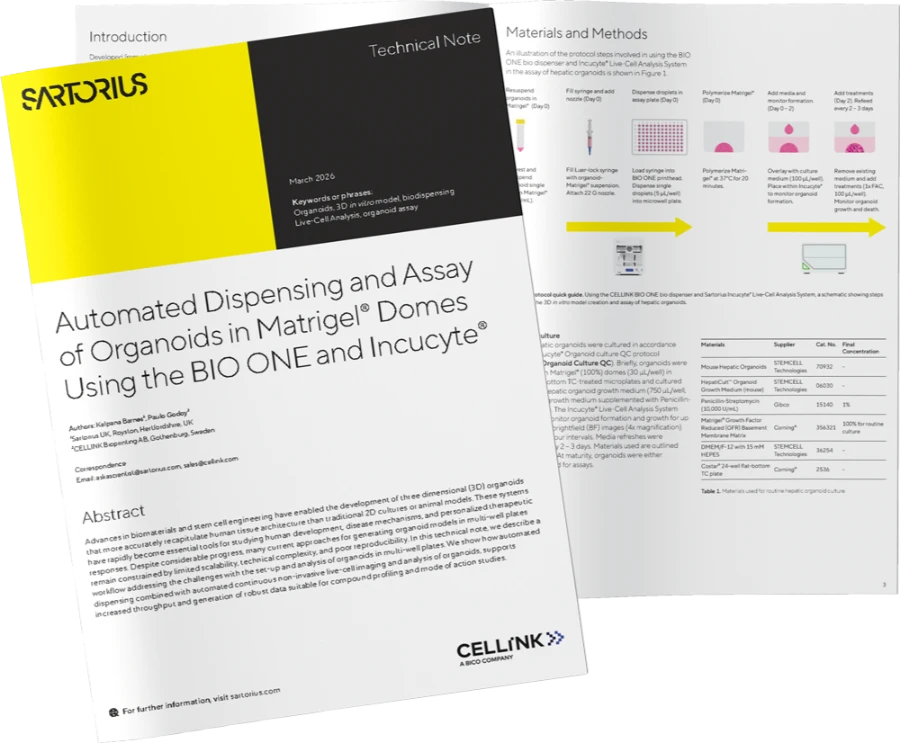
Automated dispensing and assay of organoids in Matrigel® domes
Download this free workflow guide showcasing how to use the CELLINK BIO ONE and Sartorius Incucyte® Live‑Cell Analysis System for standardized, scalable organoid assays in multi-well plates.
Method for automated organoid generation in 96 wells
Combining research-proven biomaterials and tools
Demonstrated suitability for quantitative pharmacology


 Office
 Distributor
 Customer